
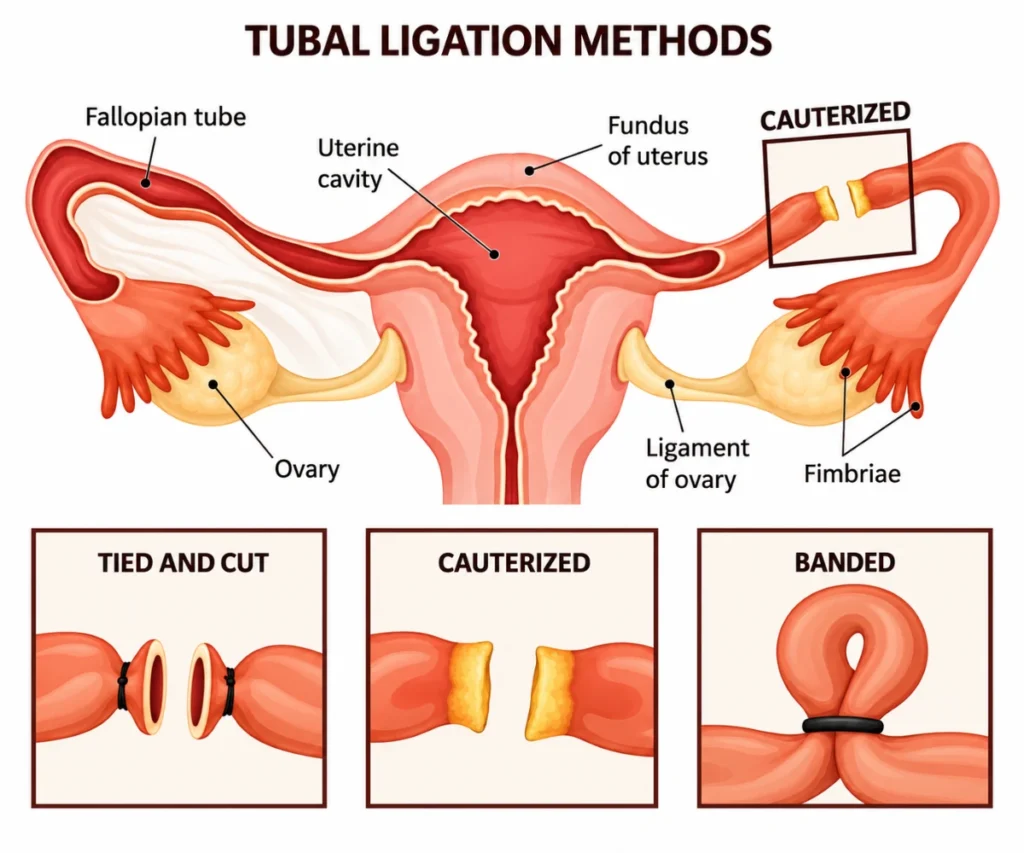
Tubal ligation and tubal cannulation sound similar because both procedures involve the fallopian tubes. However, they are performed for very different reasons.
Tubal ligation is intended to prevent future pregnancy. Tubal cannulation is performed in selected women with a blocked fallopian tube to try to restore tubal patency and improve the possibility of pregnancy.
This difference is especially important if you are researching treatment after a fertility test has shown a blocked fallopian tube. Tubal cannulation is not a form of sterilisation, and it does not reverse a previous tubal ligation.
The appropriate procedure depends on the problem being treated, the location and cause of any tubal blockage, your age, other fertility factors and your future reproductive plans.
What is the difference between tubal ligation and tubal cannulation?
The main difference is their purpose.
| Tubal Ligation | Tubal Cannulation | |
| Main purpose | Permanent contraception | Treatment of selected fallopian tube blockages |
| Effect on tube | Blocks, divides, seals or removes part/all of the tube | Attempts to reopen a blocked tube |
| Pregnancy goal | Prevent pregnancy | Potentially improve chance of pregnancy |
| Usually considered for | Permanent contraception where medically appropriate | Selected proximal tubal obstruction |
| Is it permanent? | Intended to be permanent | No |
| Does it guarantee the intended outcome? | No contraceptive procedure is 100% effective | No pregnancy can be guaranteed after successful cannulation |
| Can it reverse tubal ligation? | Not applicable | No |
The two procedures should therefore not be considered alternative ways of doing the same thing.
What is tubal ligation?
Tubal ligation is a surgical method of permanent contraception.
The fallopian tubes provide the pathway through which sperm and egg normally meet. During tubal sterilisation, this pathway is interrupted so fertilisation cannot occur in the usual way.
Depending on the technique, the tubes may be blocked, divided, sealed, partly removed or completely removed.
The ovaries normally remain in place, so tubal ligation does not usually stop ovarian hormone production or menstruation.
The American College of Obstetricians and Gynecologists’ guidance on sterilization explains that female sterilisation works by closing or removing the fallopian tubes and should be regarded as permanent contraception.
Tubal ligation is highly effective, although pregnancy can occasionally occur. ACOG reports that fewer than 1 in 100 women become pregnant within the first year following tubal sterilisation.
What is tubal cannulation?
Tubal cannulation is a procedure used to assess and potentially reopen a proximal fallopian tube blockage.
“Proximal” means the blockage is located at the part of the tube closest to the uterus.
During cannulation, a very fine catheter and guidewire are carefully passed towards the opening of the fallopian tube. If an obstruction is confirmed and can be crossed safely, the catheter or guidewire may restore the opening of the tube.
The American Society for Reproductive Medicine guidance on tubal surgery recommends tubal cannulation for proximal tubal obstruction in appropriately selected younger women without other significant infertility factors.
Tubal cannulation is therefore a fertility-related procedure, not a contraceptive procedure.
Why might a fertility test show that the fallopian tubes are blocked?
The fallopian tubes are commonly assessed using a hysterosalpingogram (HSG).
During an HSG, contrast material is introduced through the cervix while X-ray imaging is used to see whether the contrast passes through the uterus and fallopian tubes.
If contrast does not pass through a tube, it may appear blocked.
However, an apparent blockage close to the uterus does not always mean that permanent structural damage is present.
ASRM notes that proximal tubal obstruction can result from several causes, including mucus or debris, temporary spasm at the opening of the tube, or true anatomical blockage caused by fibrosis or conditions such as pelvic inflammatory disease, endometriosis or salpingitis isthmica nodosa.
This is one reason an HSG result should be interpreted alongside the woman’s clinical history rather than treating every reported blockage in exactly the same way.
Can tubal cannulation unblock fallopian tubes?
Yes, tubal cannulation can reopen some proximal fallopian tube blockages, but it is not suitable for every type of tubal disease.
If the blockage is caused by material within the proximal tube or an obstruction that can be crossed safely with the guidewire, patency may be restored.
If gentle cannulation cannot pass through the obstruction, the procedure is usually stopped rather than forcing the instrument through the tube.
ASRM reports that when cannulation cannot overcome an obstruction, true anatomical occlusion from conditions such as fibrosis or chronic inflammation is frequently present.
This distinction is important.
A tube that appears blocked because of temporary spasm is very different from a tube that has extensive structural damage.
Who may be suitable for tubal cannulation?
Tubal cannulation is most relevant when testing suggests a proximal tubal obstruction and the remainder of the reproductive assessment is favourable.
Potential suitability may depend on:
- whether the obstruction is proximal rather than severe distal tubal disease
- the condition of the remaining fallopian tube
- age
- ovarian reserve
- sperm analysis
- previous pelvic infection
- endometriosis
- previous ectopic pregnancy
- duration of infertility
- other causes of infertility
ASRM specifically supports tubal cannulation for proximal obstruction in younger women without other significant infertility factors.
That does not mean age alone determines treatment. It means that the likelihood of pregnancy after restoring tubal patency needs to be considered within the complete fertility picture.
For Dr. Neha, this is why reviewing an HSG report alone is not enough. The imaging finding needs to be considered alongside the patient’s menstrual and pregnancy history, previous infections or pelvic surgery and other fertility investigations.
How is tubal cannulation performed?
Tubal cannulation may be performed using fluoroscopic guidance or through a hysteroscopic approach.
With fluoroscopic cannulation, a catheter is passed through the cervix into the uterus and directed towards the opening of the affected fallopian tube. Contrast can be used to confirm the site of obstruction.
A smaller catheter and flexible guidewire are then carefully advanced into the proximal tube.
A hysteroscopic approach allows the opening of the fallopian tube inside the uterus to be visualised directly. In some circumstances, laparoscopy may also be used to evaluate the outside of the tubes and other pelvic structures.
ASRM reports comparable tubal-patency outcomes between fluoroscopic and hysteroscopic techniques.
The most appropriate approach depends on the suspected problem and whether other pelvic conditions also need assessment.
Does tubal cannulation involve abdominal surgery?
Not necessarily.
Fluoroscopic tubal cannulation can be performed by passing instruments through the cervix and uterus, without making an abdominal incision.
A hysteroscopic procedure also accesses the uterus through the cervix.
However, laparoscopy may sometimes be used alongside hysteroscopy, particularly when the doctor needs to assess the outside of the tubes, confirm distal tubal anatomy or investigate other pelvic conditions.
This is different from tubal ligation, which is usually a surgical procedure involving abdominal access when performed laparoscopically or through mini-laparotomy.
Can you get pregnant after tubal cannulation?
Yes, pregnancy can occur after successful tubal cannulation, but reopening the tube does not guarantee pregnancy.
Restoring tubal patency addresses one possible fertility problem. Pregnancy still depends on many other factors, including age, ovulation, ovarian reserve, sperm quality and the health and function of the fallopian tube after it has been reopened.
ASRM cites a meta-analysis in which the pooled cumulative clinical pregnancy rate after tubal cannulation was approximately 22% at six months and 26% at 12 months, increasing only modestly thereafter. The pooled live-birth rate was approximately 22%.
These figures should not be interpreted as an individual prediction.
A younger woman with isolated proximal obstruction and otherwise reassuring fertility investigations may have a very different outlook from a woman with additional infertility factors.
Is tubal cannulation successful?
Success needs to be defined carefully. There are at least two different outcomes:
- Technical success: Was the blocked tube successfully reopened?
- Reproductive outcome: Did pregnancy and ultimately live birth occur afterward?
A technically successful cannulation does not automatically result in pregnancy.
ASRM also notes that approximately one-third of tubes in which patency is restored may later become blocked again.
This is why it would be misleading to advertise tubal cannulation using only a high “tube-opening” percentage without explaining pregnancy outcomes, re-occlusion and other fertility factors.
For a patient, the more useful question is not simply “Can the tube be opened?” but “If it can be opened, how likely is that to meaningfully improve my chance of pregnancy?”
That requires individual fertility assessment.
What are the risks of tubal cannulation?
Tubal cannulation is less invasive than abdominal tubal surgery, but it still has potential risks.
One recognised procedural risk is perforation of the fallopian tube. ASRM reports tubal perforation rates of approximately 3% to 11% in published data, while noting that reported perforations in the referenced studies generally did not lead to clinical consequences.
Pregnancy after treatment of tubal disease also requires appropriate early assessment because tubal abnormalities can be associated with ectopic pregnancy.
In the ASRM-reviewed evidence, the pooled ectopic pregnancy rate after tubal cannulation was approximately 4%.
These population-level figures should be discussed in context rather than used to predict an individual patient’s outcome.

Tubal ligation vs tubal cannulation for pregnancy
If your goal is pregnancy, the distinction is straightforward.
Tubal ligation is intended to prevent pregnancy.
Tubal cannulation may be used to improve the possibility of pregnancy when an appropriate proximal tubal blockage is present.
Tubal cannulation does not undo the structural changes deliberately created during sterilisation.
This is particularly important because online searches for “opening tubes” can sometimes lead women with previous tubal ligation to assume that cannulation is a simpler form of tubal reversal. It is not.
Can tubal cannulation reverse tubal ligation?
No. Tubal cannulation is not a standard method for reversing tubal ligation.
Tubal ligation deliberately interrupts the fallopian tubes. Depending on the original operation, sections of tube may have been divided, sealed or removed.
Cannulation, in contrast, is designed primarily to pass through selected proximal obstructions from inside the uterus.
ASRM identifies microsurgical tubal anastomosis as the recommended surgical technique for tubal ligation reversal when reversal is appropriate.
Even then, reversal may not be possible or advisable in every woman.
Tubal ligation reversal or IVF: what happens if pregnancy is desired later?
A woman who wants pregnancy after previous tubal sterilisation may need to discuss tubal reversal and IVF, rather than tubal cannulation.
Which route is more appropriate depends on several factors.
These include the original sterilisation method, remaining healthy tube length, age, ovarian reserve, sperm factors, other infertility conditions and how many future pregnancies are desired.
ACOG emphasises that sterilisation should be considered permanent and that neither reversal surgery nor assisted reproductive treatment can guarantee a future pregnancy.
This is one reason future reproductive plans need careful consideration before permanent contraception is undertaken.
When might IVF be recommended instead of tubal cannulation?
IVF may be more appropriate when the tubal problem is unlikely to be corrected effectively with cannulation or when other fertility factors are present.
IVF is generally preferred when proximal obstruction cannot be overcome with gentle cannulation and true anatomical occlusion is suspected. IVF may also be favoured in older women or when significant male-factor infertility is present.
Other situations, such as severe distal tubal damage or hydrosalpinx, require different management and should not automatically be treated with cannulation.
The treatment should therefore follow the diagnosis rather than choosing a procedure first.
Treatment options for blocked fallopian tubes
There is no single treatment for every blocked fallopian tube. Management may include further assessment, tubal cannulation, other forms of tubal surgery or IVF depending on where the blockage is located and why it has occurred.
An HSG suggesting proximal obstruction may sometimes need confirmation because temporary spasm or technical factors can create the appearance of blockage.
By contrast, a severely damaged distal tube or hydrosalpinx represents a different problem and may require a different surgical or fertility strategy.
For patients, this means that the phrase “blocked tube” is a finding, not a complete treatment plan.
Which is better: tubal ligation or tubal cannulation?
Neither procedure is “better” because they treat opposite reproductive goals.
If permanent pregnancy prevention is medically indicated and appropriate, tubal sterilisation may be considered.
If pregnancy is desired and an appropriate proximal tubal obstruction has been identified, tubal cannulation may be one treatment option.
Comparing the two by success rate alone therefore does not make clinical sense.
The important question is which procedure is right for the patient’s condition and future pregnancy plans.
Tubal ligation in Dubai: an important regulatory distinction
For patients in Dubai, tubal ligation also carries a regulatory consideration that does not apply to tubal cannulation in the same way.
Article 15 of the UAE Medical Liability law states that an intervention for the purpose of sterilising a woman requires the opinion of a specialised medical committee comprising at least three physicians who determine that pregnancy or delivery would pose a definite risk to the mother’s life. The provision also specifies written approval from the woman and informing the husband.
Tubal cannulation is different because its purpose is not sterilisation. It is performed in selected cases to investigate or treat tubal obstruction in women seeking fertility.
This distinction is important when reading international information online because sterilisation laws and requirements are not identical in every country.
How Dr. Neha approaches a tubal blockage finding
When an HSG reports a blocked fallopian tube, the next decision should not be based on that single phrase alone.
Dr. Neha Lalla, Consultant Obstetrician & Gynaecologist in Dubai, considers where the blockage appears to be, whether one or both tubes are affected, previous pregnancies, ectopic pregnancy history, pelvic infection or surgery, age and other fertility factors before discussing the next step.
For some women, proximal tubal cannulation may be relevant.
For others, further assessment may show that cannulation is unlikely to address the underlying problem, and another fertility approach may be more appropriate.
That distinction helps avoid both unnecessary procedures and unrealistic expectations about what reopening a fallopian tube can achieve.
Conclusion: Which procedure applies to you
Tubal ligation and tubal cannulation are different procedures, even though both involve the fallopian tubes.
- Tubal ligation is done to prevent pregnancy permanently.
- Tubal cannulation is used to reopen certain blocked fallopian tubes when a woman wants to become pregnant.
If a fertility test shows a blocked fallopian tube, the next step is to find out where the blockage is, what is causing it, and whether treating it could improve the chances of pregnancy.
If you have had tubal sterilisation and later want to become pregnant, tubal cannulation should not be considered a reversal procedure. Tubal reversal and IVF are separate options that need to be considered based on your individual fertility situation.
Dr. Neha Lalla considers the patient’s complete fertility history rather than looking at only the HSG result. This may include the location of the blockage, previous pregnancies, pelvic surgery or infection, age, and other fertility factors.
If you have been told that one or both fallopian tubes are blocked, speaking with a qualified obstetrician and gynaecologist can help you understand whether you need further tests, tubal cannulation, another procedure, or fertility treatment.
Frequently Asked Questions
1. Is tubal cannulation the same as tubal ligation?
No. Tubal ligation deliberately interrupts the fallopian tubes to prevent pregnancy. Tubal cannulation attempts to reopen selected proximal tubal blockages in women who may be trying to conceive.
2. Can tubal cannulation unblock both fallopian tubes?
It may be possible to cannulate one or both tubes when appropriate proximal obstruction is present. Suitability depends on the location and cause of the blockage and the condition of the remainder of each tube.
3. Can you get pregnant naturally after tubal cannulation?
Yes, natural pregnancy may occur if tubal patency is restored and other fertility factors are favourable. Successful reopening of the tube does not guarantee pregnancy.
4. How successful is tubal cannulation for pregnancy?
ASRM-reviewed evidence reported pooled clinical pregnancy rates of approximately 22% at six months and 26% at 12 months, with a pooled live-birth rate of about 22%. Individual outcomes can differ considerably.
5. Can a fallopian tube become blocked again after cannulation?
Yes. ASRM reports that approximately one-third of tubes in which patency is restored may re-occlude.
6. Is tubal cannulation suitable for hydrosalpinx?
Tubal cannulation is primarily used for selected proximal obstruction. Hydrosalpinx usually represents distal tubal damage and requires a different assessment and treatment strategy.
7. Can tubal cannulation reverse sterilisation?
No. Cannulation should not be confused with tubal reversal. Microsurgical tubal anastomosis may be considered for reversal in selected women, while IVF is another potential route to pregnancy.
8. Is tubal ligation permanent?
Yes. Tubal ligation is intended as permanent contraception. Although reversal may sometimes be attempted, it cannot be relied upon to restore fertility.
9. What happens if tubal cannulation does not open the tube?
If gentle cannulation cannot cross the obstruction, true structural occlusion may be present. Further management can include IVF or, in selected circumstances, other tubal surgery depending on age and other fertility factors.
10. Should every blocked tube be treated?
No. The location of the blockage, whether it affects one or both tubes and the presence of other fertility factors all influence whether treatment is necessary. ASRM notes that intervention is not necessarily required for an isolated unilateral proximal obstruction when there are no distal abnormalities.
Medical Disclaimer
This article provides general educational information and does not replace individual medical advice, diagnosis or fertility assessment. Treatment for fallopian tube obstruction depends on the location and cause of the blockage, age, reproductive history and other fertility factors.